Sep 23, 2026OEM & Manufacturing Insights
Brake Pad Cross Reference Guide: FMSI, WVA & OE Numbers
Learn how to cross-reference brake pads using FMSI, WVA and OE numbers, verify fitment, and reduce sourcing errors before placing bulk orders.
Brake Pad Cross Reference Guide: How to Match FMSI, WVA and OE Numbers
For brake pad distributors and importers, identifying the correct brake pad is not always as simple as matching one part number.
The same brake pad shape may appear under an FMSI number, a WVA number, several OE numbers, supplier-specific references, and different vehicle applications. At the same time, similar-looking pads may have important differences in dimensions, hardware, brake systems or axle position.
That is why brake pad cross reference is an important step before quotation, sampling and bulk ordering.
A reliable cross-reference process should answer one basic question:
Are we talking about exactly the same brake pad?
This guide explains how professional buyers can use FMSI, WVA and OE numbers together with vehicle and dimensional data to reduce identification errors.
What Is a Brake Pad Cross Reference?
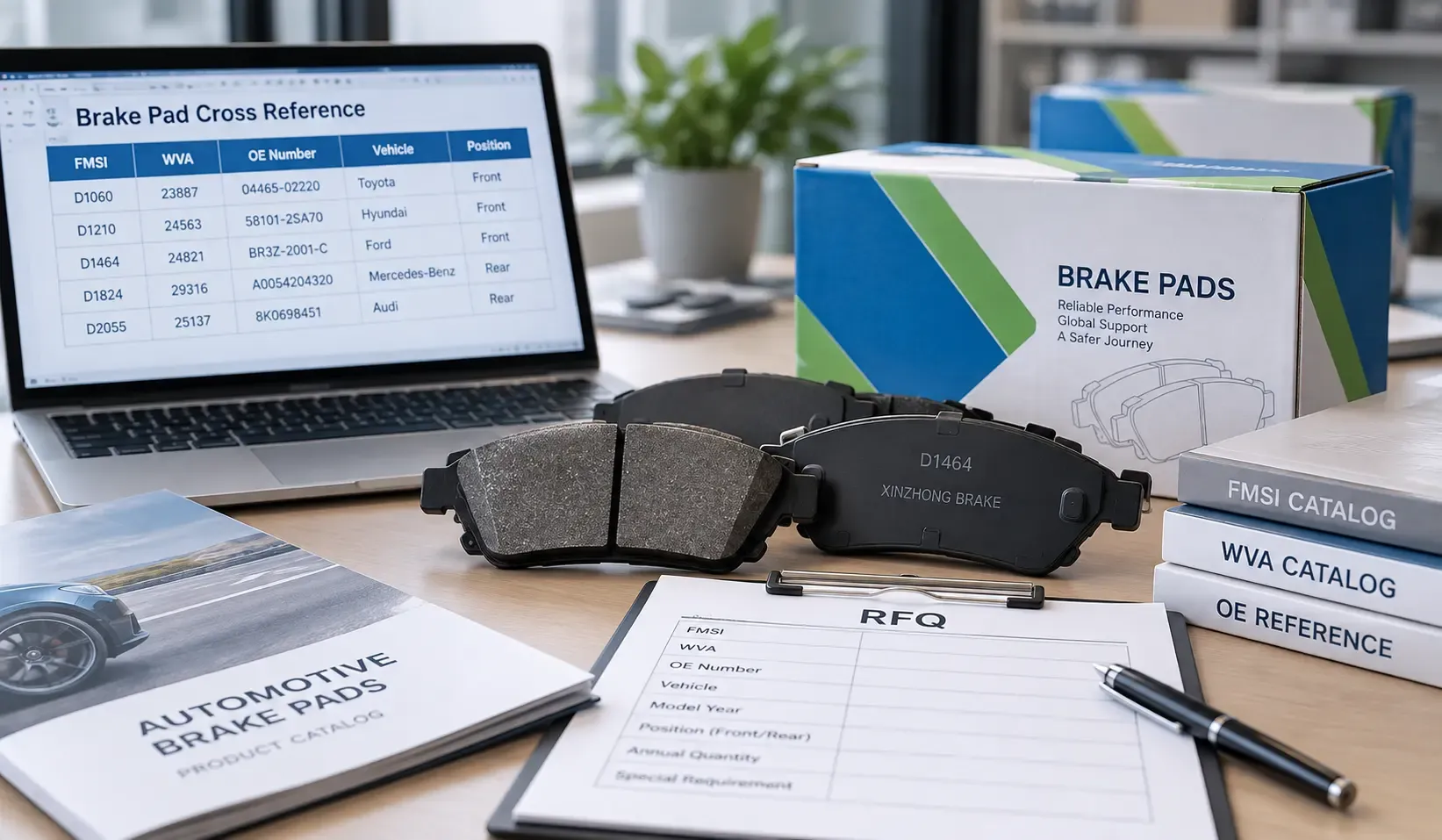
A brake pad cross reference is the process of matching different identification numbers that refer to the same or compatible brake pad application.
For example, a distributor may provide:
- An OE number from a vehicle manufacturer
- An FMSI number commonly used in the North American aftermarket
- A WVA number commonly used in European brake catalogs
- An existing supplier's part number
- Vehicle make, model and year information
A brake pad manufacturer then compares these references with its own database and product specifications to identify the corresponding brake pad.
The purpose is not simply to find a similar number.
The purpose is to verify that the application, pad shape, dimensions and braking configuration all match.
FMSI, WVA and OE Numbers: What Is the Difference?
These numbers serve different purposes, which is why professional sourcing should not treat them as interchangeable labels.
FMSI Numbers
FMSI references are widely used in the North American friction-material aftermarket.
A typical disc brake pad reference may appear as a D-number, such as Dxxxx.
For distributors working with American, Japanese, Korean and other vehicle applications sold in North America, FMSI numbers can be an efficient starting point for identifying pad shapes.
However, the FMSI number should still be checked against the actual application and product specifications.
WVA Numbers
WVA numbers are widely used in European brake-component identification and aftermarket catalogs.
For buyers sourcing brake pads for European applications, WVA can provide an important common reference between different catalogs and suppliers.
Depending on the application, buyers may encounter multiple related references, so WVA should be used together with dimensional and vehicle information rather than in isolation.
OE Numbers
OE numbers originate from vehicle manufacturers or their parts systems.
One brake pad may be associated with multiple OE references because of:
- Different vehicle brands sharing platforms
- Superseded part numbers
- Different model years
- Regional catalog differences
- Manufacturer updates
This means an OE number is extremely useful, but an OE match alone should not automatically be treated as final fitment confirmation.
Why One Brake Pad Can Have Multiple Reference Numbers
This is where brake pad sourcing becomes confusing.
A single pad shape may be used across several vehicle models and brands. The same physical brake pad can therefore accumulate multiple OE references and aftermarket identification numbers.
Conversely, one vehicle model may use different brake systems depending on:
- Production year
- Engine
- Trim level
- Market
- Caliper manufacturer
- Wheel or brake package
So a request such as “I need front brake pads for this vehicle” may not contain enough information for an accurate quotation.
This is particularly important for distributors ordering multiple references in one shipment. A small identification error repeated across dozens of SKUs can become an expensive inventory problem.
How to Cross-Reference Brake Pads Correctly
For B2B sourcing, we recommend checking several layers of information rather than relying on a single reference.
1. Start With the Available Reference Number
Send the supplier whatever reliable reference you already have:
- FMSI
- WVA
- OE
- Existing supplier number
Providing multiple references is even better.
2. Confirm the Axle Position
Always confirm whether the pads are front or rear.
Front and rear pads for the same vehicle are different products, and vehicle descriptions alone can easily create confusion.
3. Check Vehicle Application
Verify the available vehicle information, including:
- Make
- Model
- Model year
- Engine or version where relevant
For applications with multiple braking systems, additional information may be required.
4. Compare Brake Pad Dimensions
Length, height and thickness provide another useful verification layer.
If the reference number appears correct but the dimensions differ significantly, the application should be investigated before ordering.
5. Compare the Pad Shape
Visual comparison is especially useful when migrating from an existing supplier.
A drawing or clear product photo can help verify:
- Backing plate outline
- Ears and locating points
- Slots
- Chamfers
- Wear-sensor position
- Hardware configuration
The visual check should support reference-number verification rather than replace it.
6. Confirm Special Hardware or Features
Some brake pad sets may require additional components or configurations, such as:
- Wear sensors
- Clips
- Shims
- Springs
- Specific accessories
These details can affect both the quotation and the final supplied product.
A Better Way for Distributors to Send a Brake Pad RFQ
If you are requesting quotations for dozens or hundreds of brake pad references, sending only vehicle names creates unnecessary back-and-forth.
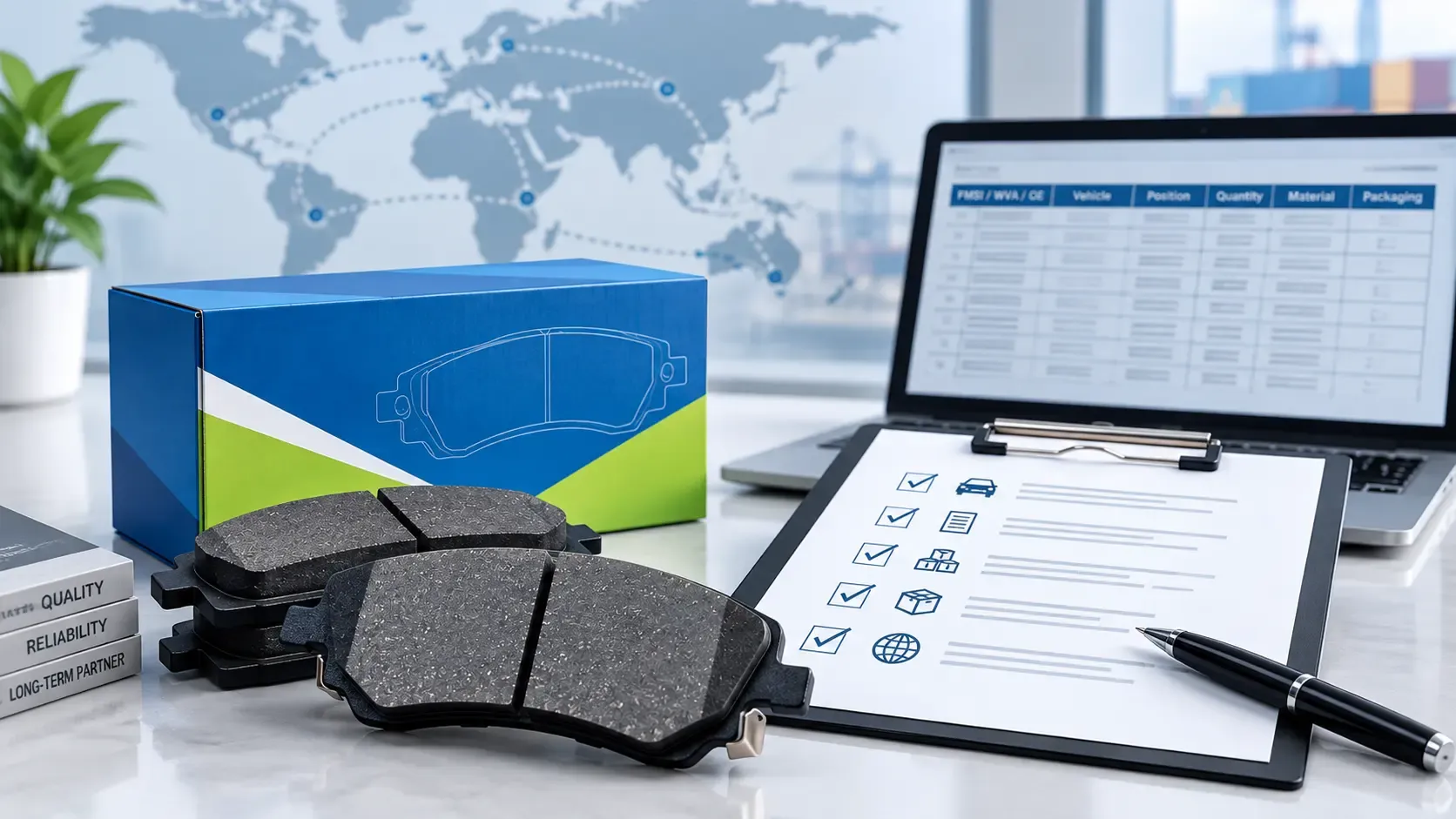
A more efficient RFQ sheet can include:
Information | Recommended |
|---|---|
FMSI | If available |
WVA | If available |
OE Number | If available |
Vehicle | Recommended |
Model Year | Recommended |
Axle Position | Required |
Existing Supplier Number | Useful |
Annual / Trial Quantity | Recommended |
Material Requirement | If specified |
Private Label Requirement | If required |
You do not need every field for every reference.
But the more reliable identification data available at the beginning, the easier it is for both buyer and manufacturer to identify questionable applications before production.
Common Brake Pad Cross-Reference Mistakes
One common mistake is assuming that vehicle make and model are enough.
They often are not.
Another is assuming that one OE number always corresponds to one permanent aftermarket configuration. OE references can be superseded, and applications may vary by production period or brake system.
A third mistake is relying only on product appearance.
Two brake pads can look very similar in a photograph while having different dimensions or mounting details.
For bulk purchasing, cross-reference work should therefore combine reference numbers + application + dimensions + physical configuration whenever possible.
Cross-Referencing When Changing Brake Pad Suppliers
Cross-reference work becomes particularly important when a distributor wants to add a second supplier or move part of an existing product range to another manufacturer.
You do not necessarily need to rebuild your purchasing list from zero.
A practical starting point is to send your current product list containing the reference numbers you already use.
The new manufacturer can then cross-check the list against its own range and separate it into:
Directly Matched References
Applications that can be identified with sufficient confidence.
References Requiring Confirmation
Items where additional OE, vehicle, dimension or pad-shape information is needed.
Currently Unavailable References
Applications outside the manufacturer's existing range or requiring further development.
This gives the buyer a much clearer picture of actual range coverage before discussing a bulk order.
How Xinzhong Brake Supports Cross-Reference Checking
Xinzhong Brake supports distributors, importers and private-label buyers with cross-reference verification before quotation and sampling.
Our brake pad range covers 6,600+ reference numbers, with ceramic, semi-metallic, low-metallic and NAOformulation options for different market requirements.
For a new sourcing project, buyers can send us an existing purchasing list containing OE, FMSI, WVA or current supplier references.
Instead of immediately sending a large generic catalog, we can first cross-check the requested applications and identify which references are available for further quotation or sample evaluation.
This is particularly useful for:
- Distributors adding a second brake pad supplier
- Importers expanding their existing range
- Private-label brake pad programs
- Buyers trying to cover slow-moving or difficult-to-source references
- Customers migrating an existing SKU list to a new manufacturer
FAQ
Can I Identify a Brake Pad Using Only an OE Number?
An OE number is a strong starting point, but additional verification may still be necessary. Vehicle application, axle position, dimensions and pad shape can help confirm the match before bulk ordering.
Is an FMSI Number Enough to Request a Quotation?
In many cases, an FMSI number allows a manufacturer to identify the required pad shape quickly. However, additional vehicle or dimensional information may be requested if the application has multiple configurations.
What If I Only Have My Current Supplier's Part Numbers?
Send the list together with any available OE, FMSI, WVA, vehicle information, catalog screenshots or product drawings. These can be used to build a cross-reference list.
Can You Cross-Reference a Complete Distributor Product List?
Yes. For larger sourcing projects, an existing SKU or purchasing list is often more useful than requesting products one by one. References can be checked first before moving to quotation and sample selection.
Should I Verify Brake Pad References Again Before Bulk Production?
Yes. Final application and specification confirmation before production helps reduce incorrect fitment, returns and slow-moving inventory.
Need to Cross-Reference Your Brake Pad List?
If you already have a purchasing list, you do not need to search our catalog reference by reference.
Send us your OE, FMSI, WVA or existing supplier numbers.
Xinzhong Brake can cross-check your list against our current range and identify matching brake pad references before quotation.
This gives both sides a cleaner starting point for sampling, pricing and bulk-order discussions.