OEM & Manufacturing Insights
Brake Pad Formulation Guide for Distributors & Buyers
Learn how brake pad formulations affect noise, dust, wear, braking performance and cost, and what distributors should consider when choosing a supplier.
Brake Pad Formulation: What Distributors Should Know Before Choosing a Supplier
Two brake pads can both be described as ceramic, fit the same vehicle, and look almost identical — yet perform very differently in noise, dust, braking feel, wear life and temperature stability.
For distributors and importers, this is an important point to understand:
The material category on a quotation does not tell you the whole story. The actual brake pad formulation matters.
A reliable brake pad supplier should not simply ask whether you want ceramic, semi-metallic or low-metallic pads. They should also understand your target market, vehicle applications, performance priorities and price positioning.
This guide explains what brake pad formulation means, why different formulations behave differently, and what buyers should consider before approving a product for bulk orders.
What Is a Brake Pad Formulation?
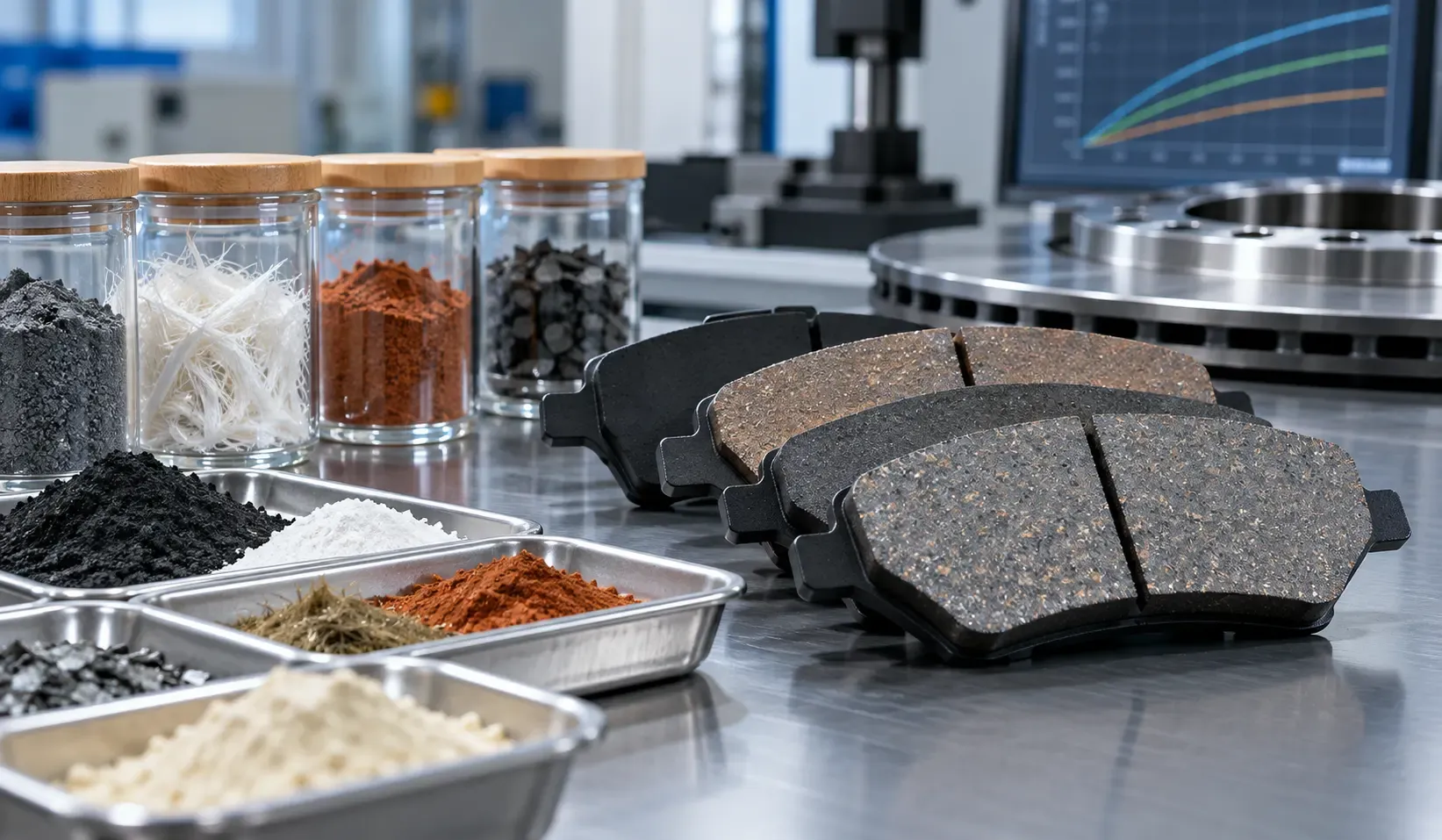
A brake pad friction material is made from a combination of different ingredients rather than one single material.
Depending on the formulation, these may include:
- Fibers
- Fillers
- Friction modifiers
- Abrasives
- Lubricants
- Binders
- Metallic or mineral components
The proportions and types of these ingredients influence how the brake pad performs.
This is why simply saying “ceramic brake pad” or “semi-metallic brake pad” is not enough to completely define a product.
Two manufacturers may both offer a ceramic pad for the same application, but their formulations may produce different results in terms of noise, dust, wear, pedal feel and braking performance.
Why Brake Pad Formulation Matters to Distributors
For a distributor, formulation affects more than technical specifications.
It can directly affect:
- Customer complaints
- Product returns
- Brand reputation
- Market positioning
- Selling price
- Repeat orders
Imagine two brake pads with the same FMSI or OE reference.
One produces relatively low dust and quiet operation but costs more. Another provides stronger initial braking response at a lower cost but generates more visible dust.
Neither is automatically the “better” product.
The right choice depends on who will buy it and where it will be used.
That is why distributors should discuss performance priorities with their brake pad manufacturer instead of selecting products only according to material names or unit prices.
The Main Performance Factors Behind a Brake Pad Formulation
When evaluating a formulation, buyers should consider several performance characteristics together.
1. Braking Performance
The most basic requirement is reliable friction performance under the intended operating conditions.
A suitable formulation should provide predictable braking behavior across the temperature range expected in normal use.
For buyers, the important question is not simply:
“Is the friction coefficient high?”
A better question is:
“Is the friction performance stable for the vehicles and driving conditions in my market?”
Extremely aggressive initial bite is not always necessary or desirable for every passenger vehicle application.
2. Noise
Brake noise is one of the most common aftermarket complaints.
Formulation can influence noise behavior, but it is not the only factor.
Brake discs, installation quality, hardware condition, vehicle design, driving conditions and pad geometry can also affect noise.
For this reason, buyers should be cautious when a supplier promises that a brake pad will be 100% noise-free under all conditions.
A more realistic approach is to evaluate how the formulation, shim, slot, chamfer and overall pad design work together to reduce noise risk.
3. Brake Dust
Many passenger-car customers prefer cleaner wheels, especially in markets where ceramic brake pads are popular.
Certain formulations can help reduce visible dust, but dust performance must be balanced against other requirements such as friction characteristics, wear and cost.
“Zero dust” should therefore not be treated as a realistic universal specification.
For distributors, it is more useful to define the acceptable balance between wheel cleanliness, braking performance and price.
4. Wear Life
Long pad life sounds attractive, but maximum wear life should not be considered independently.
The interaction between the brake pad and brake disc matters.
A formulation designed only to maximize pad life may not necessarily provide the best overall system performance.
Buyers should therefore evaluate both pad wear and rotor compatibility during product validation.
5. Temperature Performance
Driving conditions vary greatly between markets.
Urban commuting, mountainous roads, highway driving, commercial use and frequent heavy braking can expose brake pads to very different temperatures.
A formulation suitable for normal city driving may not be the ideal choice for more demanding operating conditions.
This is one reason why the same friction formulation should not automatically be used for every vehicle application and every market.
Why You Cannot Optimize Everything at the Same Time
This is one of the most important concepts for brake pad buyers.
Distributors sometimes ask for a product that has:
- No noise
- No dust
- Very strong braking
- Extremely long service life
- Excellent high-temperature performance
- Minimal rotor wear
- And the lowest possible price
In practice, friction-material development involves trade-offs.
Improving one characteristic can affect another.
For example, changing ingredients to reduce visible dust may influence braking feel, wear characteristics, manufacturing cost or other performance factors.
The goal of formulation development is therefore not to maximize one specification at all costs.
The goal is to find the right performance balance for the intended market and application.
Ceramic, Semi-Metallic, Low-Metallic and NAO Are Only the Starting Point
Material categories are useful for initial product selection, but they should not become the entire purchasing specification.
A distributor may request ceramic brake pads because customers associate ceramic products with low noise and low dust.
But there can still be significant differences between two ceramic formulations.
The same applies to semi-metallic, low-metallic and NAO products.
Buyers who want a deeper comparison of these material families can read our Brake Pad Materials Explained: Ceramic vs Semi-Metallic vs Low-Metallic vs NAO guide.
The key point is simple:
Material category tells you what family the product belongs to. Formulation determines much of how the actual product behaves.
The Same Formulation May Not Suit Every Market
A brake pad that sells successfully in one country may not automatically be the best choice for another.
Several factors can influence formulation selection:
Driving Conditions
Heavy urban traffic with frequent stop-and-go braking creates different demands from long-distance highway driving.
Climate
Temperature, humidity and environmental conditions can affect braking systems and customer expectations.
Vehicle Mix
A market dominated by compact passenger cars may require a different product strategy from one with large SUVs, pickups or commercial vehicles.
Customer Expectations
Some markets prioritize low dust and quiet braking.
Others place greater emphasis on strong braking feel, durability or competitive pricing.
Product Positioning
An economy aftermarket line and a premium private-label range should not necessarily use the same formulation strategy.
For distributors, this means the supplier should understand the commercial position of the product, not just its part number.
What Information Should You Give Your Brake Pad Supplier?
If you are developing or sourcing a brake pad range, giving the manufacturer more market information can improve product selection.
Useful information includes:
- Target country or region
- Main vehicle applications
- Passenger car or commercial vehicle use
- Preferred material category
- Target price level
- Expected product positioning
- Noise requirements
- Dust expectations
- Typical driving conditions
- Current product problems or customer complaints
For example, saying:
“We need ceramic brake pads.”
gives the supplier very little information.
Saying:
“We are developing a mid-to-premium private-label passenger-car range for our market. Low noise and low visible dust are important, but braking stability and competitive aftermarket pricing must also be maintained.”
gives the manufacturer much more useful direction.
Should Distributors Use One Formulation for Their Entire Range?
Usually, this deserves careful consideration.
Using one formulation across many references may simplify production and purchasing, but different vehicles can have different braking requirements.
Vehicle weight, brake-system design, axle position, operating temperature and intended use can all influence the appropriate friction material.
A capable manufacturer should therefore evaluate applications rather than simply applying one friction recipe to every reference without consideration.
This becomes especially important when distributors are building a broad private-label brake pad range.
Why Sample Testing Still Matters
Technical specifications and supplier explanations are useful, but buyers should validate important products before committing to large orders.
Samples allow distributors to evaluate factors such as:
- Fitment
- Braking feel
- Noise behavior
- Dust level
- Wear
- Packaging
- Product consistency
Testing is particularly valuable when changing suppliers, introducing a new formulation or launching a new private-label range.
A small trial order can also provide real-market feedback before expanding purchasing volume.
Questions to Ask a Brake Pad Manufacturer About Formulation
Before choosing a supplier, consider asking:
- How many friction formulations do you currently manufacture?
- How do you select formulations for different vehicle applications?
- Can you provide ceramic, semi-metallic, low-metallic and NAO options?
- How do you control friction-material consistency between production batches?
- What testing is performed before mass production?
- Can the formulation be adjusted for different market requirements?
- How do you address noise and dust complaints?
- Do you recommend sample testing before bulk orders?
- Can you support different formulations for private-label product lines?
- What information do you need from us before recommending a formulation?
The answers can reveal much more about a manufacturer than simply asking for its lowest price.
How Xinzhong Brake Supports Different Market Requirements
At Xinzhong Brake, we understand that different distributors do not necessarily need the same brake pad.
We offer multiple friction-material options, including ceramic, semi-metallic, low-metallic and NAO formulations, and support buyers serving different vehicle applications and market segments.
Our approach is to first understand the buyer's target market, product positioning and performance priorities, then identify suitable product options for evaluation.
For new projects, we recommend confirming reference numbers and applications first, followed by sample evaluation or a trial order before expanding to larger purchasing volumes.
This helps both sides reduce sourcing risk and establish clearer product expectations before mass production.
FAQ
Are all ceramic brake pads the same?
No. Ceramic describes a broad material category. Different manufacturers may use different ingredient combinations and formulation strategies, which can lead to differences in noise, dust, braking characteristics, wear and cost.
Can a brake pad be completely noise-free and dust-free?
It is not realistic to guarantee zero noise or zero dust under every operating condition. Brake performance is affected by the friction material as well as the brake disc, vehicle, installation, driving conditions and other factors.
Can one brake pad formulation be used for every vehicle?
A manufacturer may use formulation families across multiple applications, but vehicle weight, brake-system design, axle position and operating conditions should still be considered when selecting the appropriate product.
Should I choose brake pads based on friction coefficient alone?
No. Friction performance is important, but buyers should also consider stability, noise, dust, wear, temperature behavior, rotor compatibility and the intended application.
Can a manufacturer develop different formulations for different markets?
Manufacturers with sufficient formulation and production capability may offer different material or performance options according to market requirements, vehicle applications and product positioning.
Final Thoughts
For distributors, sourcing brake pads should go beyond asking for a part number, material type and price.
The real question is whether the product's formulation matches your vehicles, market positioning and customer expectations.
A good supplier should be able to explain not only what material they use, but also why a particular formulation is suitable for your application.
If you are sourcing brake pads for distribution, private label or aftermarket programmes, Xinzhong Brake can help cross-reference your OE, FMSI or WVA numbers and discuss suitable friction-material options for your target market.
Send us your reference list, vehicle applications or current brake pad requirements to start a technical review.