Aug 31, 2026OEM & Manufacturing Insights
How to Evaluate a Brake Pad Supplier: 10 Questions Importers Should Ask
Use these 10 questions to evaluate a brake pad supplier before bulk ordering, from product coverage and formulations to quality control, traceability and private label support.
Choosing a brake pad supplier is not simply a matter of comparing quotations.
Two manufacturers may offer the same FMSI reference at similar prices, but differ significantly in formulation control, product consistency, reference coverage, quality management and ability to support repeat orders.
For importers and aftermarket distributors, the real question is not only:
Can this supplier manufacture the brake pad?
It is:
Can this supplier repeatedly deliver the correct product, specification and quality as your business grows?
Here are 10 questions worth asking before placing a bulk brake pad order.
1. How Many Brake Pad References Can You Actually Supply?
A large catalog sounds impressive, but buyers should look beyond the headline number.
Ask the supplier whether its reference coverage matches the vehicles and markets you actually sell into.
For example, a distributor may need a mix of:
- Passenger car brake pads
- SUV and light truck applications
- Commercial vehicle references
- Front and rear axle coverage
- Popular FMSI or WVA references
- Market-specific vehicle applications
This matters because sourcing a few isolated references is relatively easy.
The real advantage comes when one manufacturer can support a meaningful portion of your product range without creating unnecessary supplier fragmentation.
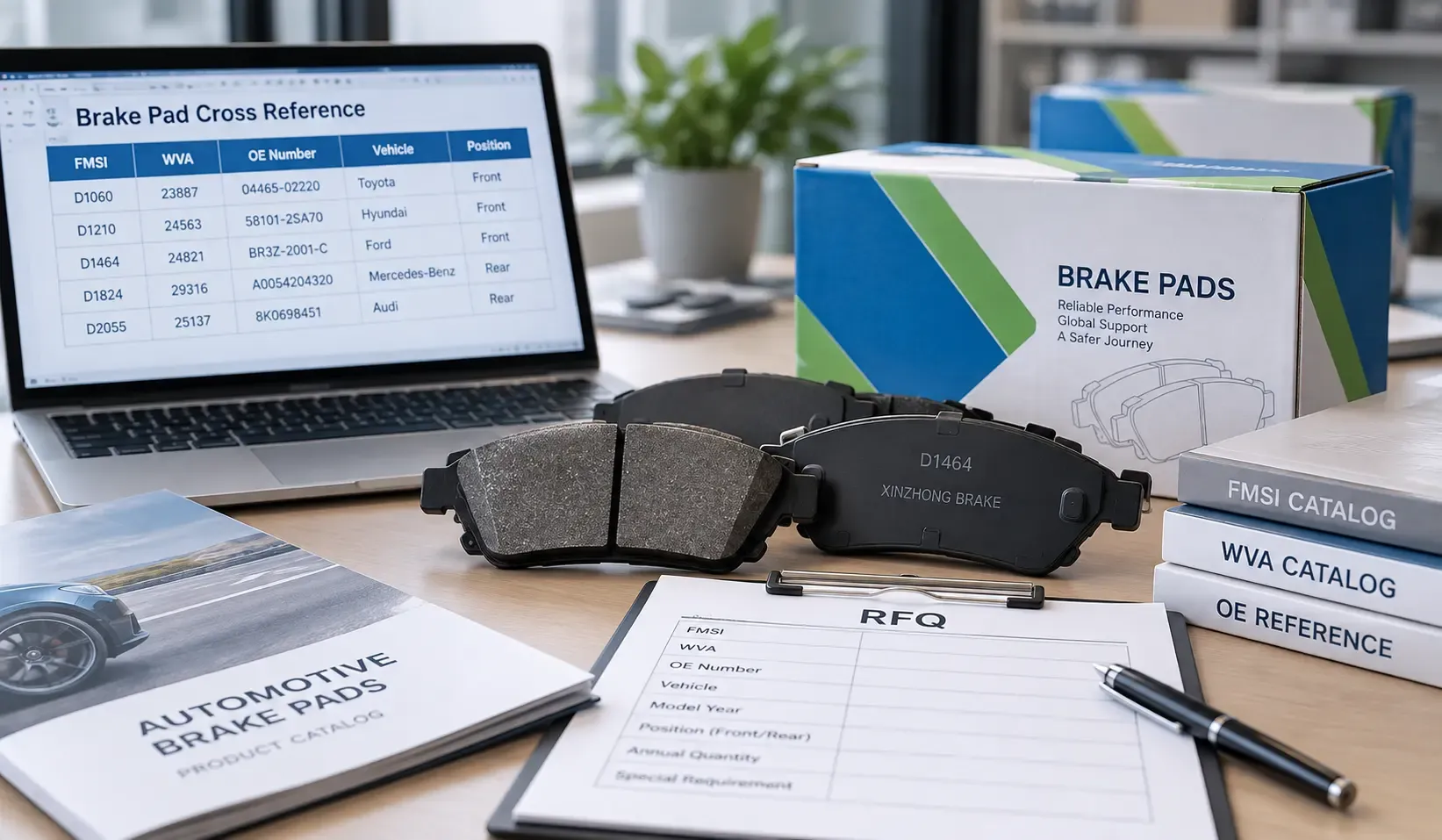
2. How Do You Verify FMSI, OE and Vehicle Fitment?
This question is often more important than asking for a catalog.
A brake pad reference should not be identified only by a vehicle name.
Depending on the application, buyers may need to verify:
FMSI / WVA / OE number + axle position + model year + brake system + vehicle configuration
Ask the supplier how product references are checked before quotation and production.
For large orders containing dozens or hundreds of SKUs, a reliable cross-reference process can reduce costly identification and fitment errors.
3. What Friction Formulations Are Available?
Do not stop at asking:
Ceramic or semi-metallic?
Those are broad formulation categories, not complete performance specifications.
Ask what formulations the manufacturer can provide for your target market and what performance differences exist between them.
Depending on the application, buyers may care about:
- Friction stability
- Noise performance
- Dust level
- Temperature resistance
- Rotor compatibility
- Pedal feel
- Service life
- Cost positioning
A useful supplier should be able to discuss why a formulation fits a particular market or product positioning rather than simply offering the cheapest compound.
4. How Do You Control Batch-to-Batch Consistency?
This is one of the questions I would put near the top of any serious supplier evaluation.
A good sample does not guarantee good repeat orders.
For distributors, the bigger risk is receiving acceptable products in the first shipment and inconsistent performance several batches later.
Ask how the manufacturer controls:
- Raw material specifications
- Mixing and weighing
- Formulation records
- Production parameters
- In-process inspection
- Finished-product inspection
- Batch identification
The goal is not to hear that the factory "has strict quality control."
The goal is to understand what is actually controlled and recorded.
5. How Are Raw Material or Formulation Changes Managed?
This is a question many buyers forget to ask.
Brake pad performance depends heavily on the friction material system. If important raw materials, suppliers or formulation ratios change without proper evaluation, product performance may also change.
Ask:
What happens if a raw material becomes unavailable?
Can a formulation be changed without customer approval?
How are material changes tested and documented?
For private-label brands trying to maintain a stable product position over several years, change control can matter as much as initial product development.
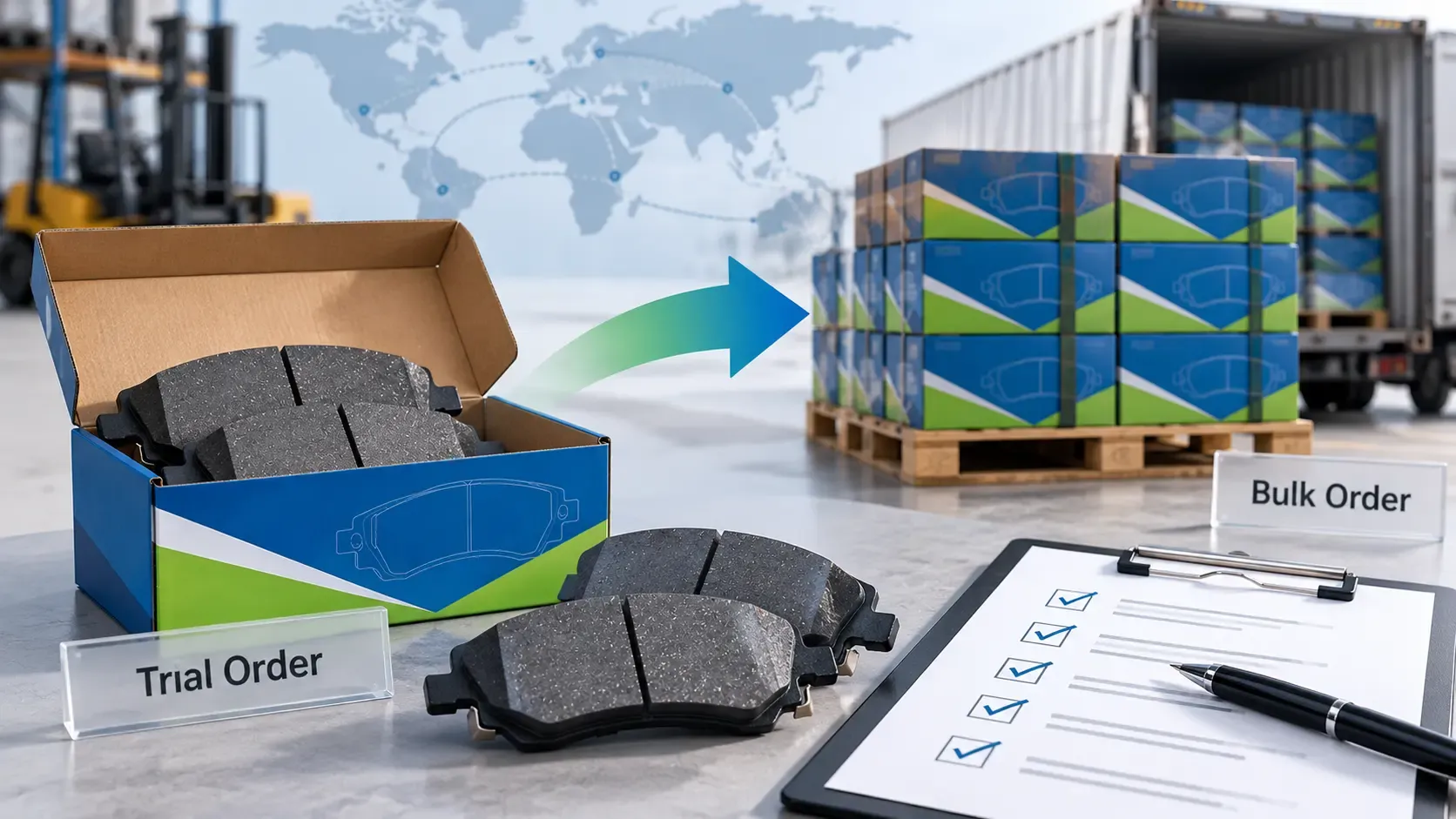
6. Will Mass Production Match the Approved Sample?
Samples are useful, but only when they represent what will later be manufactured.
Before approving a supplier, clarify whether the sample uses:
- The intended friction formulation
- The intended backing plate
- The required shim or accessories
- The agreed marking
- The agreed packaging specification
If a pre-production sample is approved, ask how that approved specification is transferred into mass production.
The important question is not:
Can you send a sample?
It is:
What prevents the bulk order from becoming different from the sample I approved?
7. What Testing and Inspection Are Performed?
Certificates can tell you whether a management system exists, but they do not replace product-level quality control.
Ask what inspections are performed during production and before shipment.
Depending on the product and customer requirements, these may include dimensional checks, appearance inspection, material or bonding checks, friction-performance evaluation and packaging verification.
If specific test reports or standards are required in your market, discuss them before quotation, not after the goods have already been produced.
8. Can You Trace a Complaint Back to a Production Batch?
Imagine receiving a customer complaint six months after delivery.
Can the supplier identify when the brake pads were produced?
Can it trace the production batch?
Can it review the relevant production or inspection records?
Traceability becomes increasingly important as order volume grows.
Ask how the supplier uses batch numbers, production records and product markings to investigate quality issues.
A supplier's ability to manufacture a product matters.
Its ability to investigate when something goes wrong matters too.
9. What Can Be Customized for Private Label Orders?
Private label is more than printing a customer's logo on a box.
Depending on the project, customization may involve:
- Friction formulation
- Backing plate marking
- Product codes
- Color boxes
- Labels
- Barcodes
- Instruction sheets
- Hardware configuration
- Carton specifications
Ask which elements can be customized and which requirements affect MOQ, tooling, lead time or cost.
It is much easier to clarify these points before artwork and production begin.
10. What Happens When There Is a Quality Problem?
This question tells you a lot about a supplier.
Do not only ask how the factory prevents defects.
Ask how it handles them.
A serious B2B supplier should have a process for receiving the complaint, identifying the affected reference and batch, investigating possible causes and discussing corrective action.
You are not looking for a factory that claims:
We never have quality problems.
That answer should make you more cautious, not less.
Manufacturing involves variation.
What matters is whether the supplier can identify, investigate and correct it systematically.
Price Still Matters — But It Should Come Later
Of course price matters.
Brake pads are competitive aftermarket products, and distributors need workable margins.
But comparing unit prices before confirming specification can be misleading.
One quotation may include a different friction formulation, shim configuration, packaging standard or quality requirement from another.
Before comparing prices, make sure you are comparing the same product specification.
Otherwise, the lowest quotation may simply represent a different product.
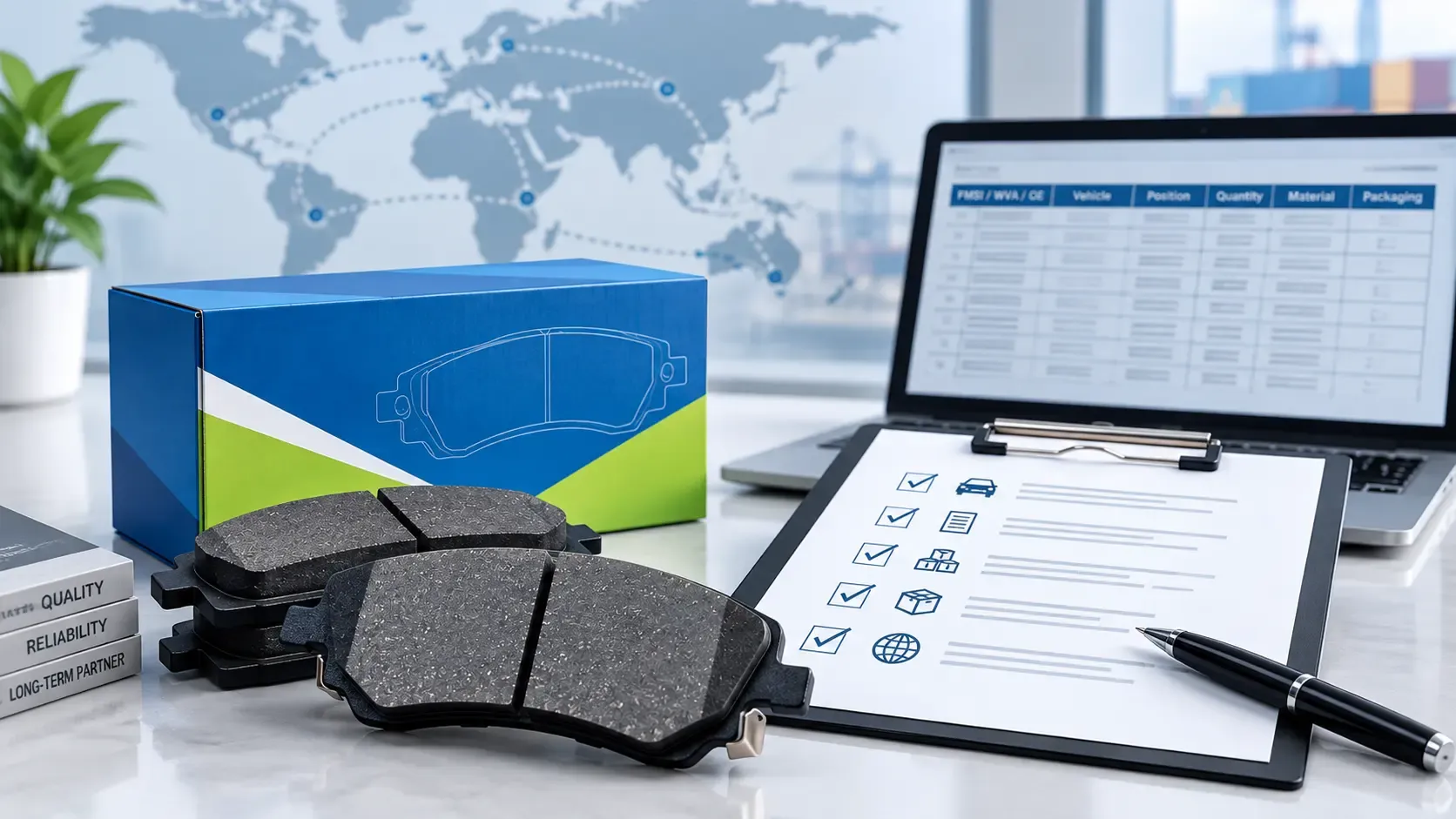
A Simple Brake Pad Supplier Evaluation Checklist
Before approving a new brake pad supplier, verify:
- Product and reference coverage
- FMSI/OE/vehicle identification capability
- Friction formulation options
- Batch consistency controls
- Raw material and formulation change control
- Sample-to-production consistency
- Testing and inspection capability
- Batch traceability
- OEM and private label capability
- Complaint and corrective-action process
Then compare:
Price + MOQ + lead time + payment terms
Commercial terms matter.
But they make much more sense after the technical and supply risks have been understood.
Conclusion
The best brake pad supplier is not necessarily the factory with the lowest quotation or the largest catalog.
For an importer or distributor, a stronger supplier is one that can correctly identify your products, maintain stable specifications, support repeat orders and respond professionally when requirements change or problems occur.
Xinzhong Brake manufactures brake pads for passenger cars, SUVs, light trucks and commercial vehicles, with more than 6,600 references and over 200 friction formulations. OEM, private label and customized formulation programs are available for global aftermarket customers.
If you are evaluating a new brake pad supply program, send us your reference list, target market, formulation requirements, estimated quantities and packaging requirements for review.
Frequently Asked Questions
What should I ask a brake pad manufacturer before ordering?
Start with product references, fitment verification, friction formulations, batch consistency, testing, traceability, MOQ, lead time and private-label requirements.
Is IATF 16949 enough to choose a brake pad supplier?
No. Certification is useful evidence of a quality-management system, but buyers should also evaluate actual product controls, production consistency, testing and traceability.
Should I request brake pad samples before bulk production?
For a new supplier, formulation or private-label program, samples can help confirm the required specification before mass production. The buyer should also confirm how the approved sample will be matched during bulk production.
How should I compare quotations from different brake pad factories?
First make sure the quotations refer to equivalent FMSI/OE references, friction formulations, accessories, packaging and quality requirements. Then compare price, MOQ, lead time and commercial terms.
What information should I send when requesting a brake pad quotation?
Send your FMSI, WVA or OE reference list where available, target vehicle applications, required formulation, quantities, destination market and packaging or private-label requirements.