Sep 14, 2026OEM & Manufacturing Insights
Brake Pad Private Label: A Complete Guide for Distributors & Importers
Learn how to source private label brake pads, from formulations and MOQ to packaging, samples and quality control. A practical guide for distributors and importers.
Brake Pad Private Label: A Complete Guide for Distributors & Importers
For brake pad distributors and importers, building a private label is not simply about putting a logo on a box.
A successful private label brake pad program involves product coverage, friction formulation, quality consistency, packaging, reference selection, testing, MOQ and long-term supply stability.
If you are planning to launch a new brake pad brand or expand an existing product line, this guide explains what you should discuss with a manufacturer before placing your first order.
What Are Private Label Brake Pads?
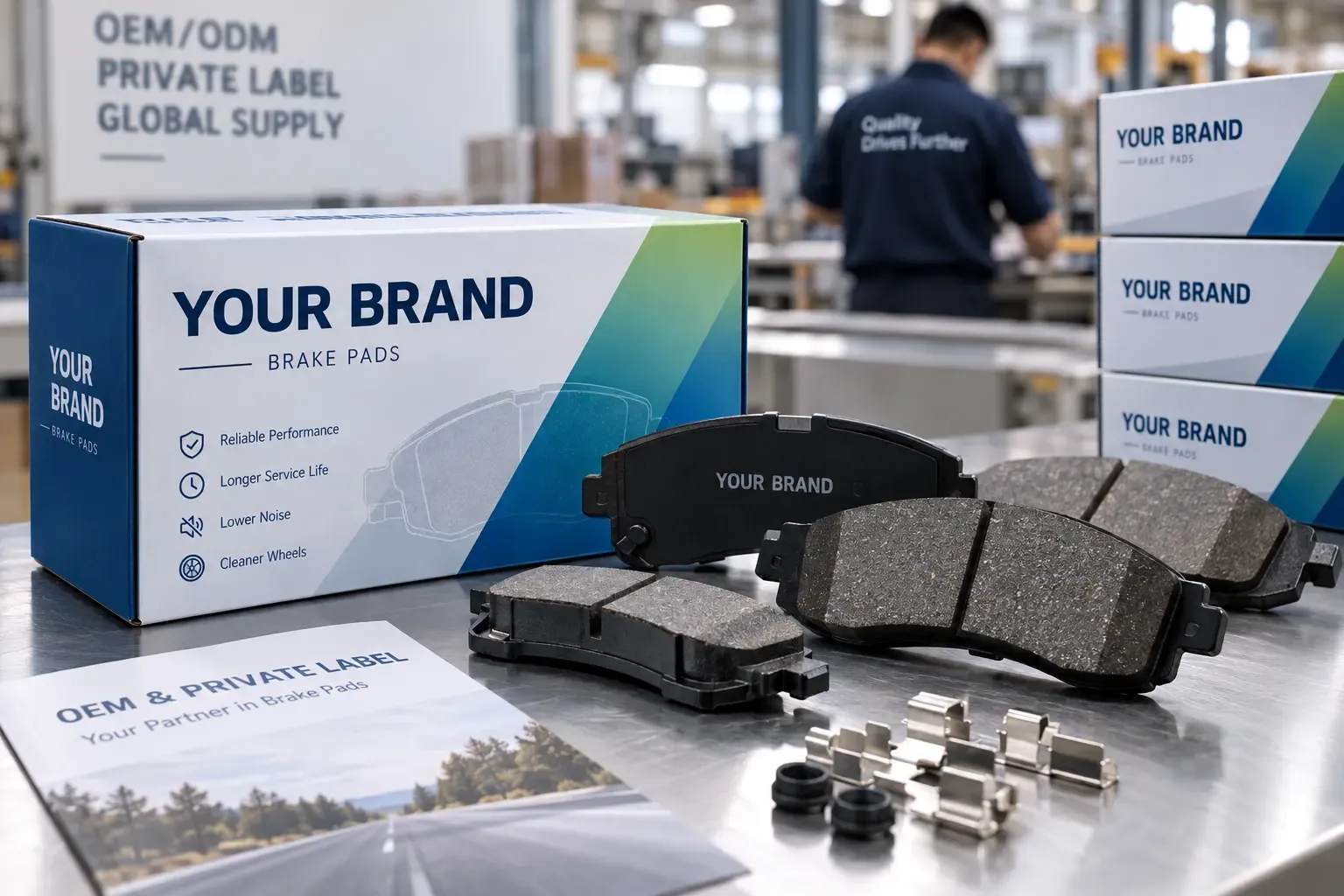
Private label brake pads are manufactured by a brake pad producer but sold under the buyer’s own brand.
Depending on the project, the manufacturer may provide:
- Brake pads under the buyer’s brand name
- Customized packaging
- Product labels and part numbers
- Different friction formulations
- Accessories and hardware
- Customized product markings
- Application and cross-reference support
For distributors, this allows you to build your own product line without investing in a complete brake pad manufacturing facility.
However, private label should not be confused with simple packaging customization.
The real value comes from building a product specification and supply system that can remain consistent across hundreds or even thousands of references.
OEM vs Private Label Brake Pads: What Is the Difference?
These terms are sometimes used interchangeably in the aftermarket, but they are not exactly the same.
Private label normally means the manufacturer produces products that are sold under the distributor’s own brand.
OEM/ODM manufacturing can involve deeper customization, such as friction formulation, product specifications, packaging, accessories or development according to a buyer’s requirements.
For many aftermarket distributors, the actual project contains elements of both.
When choosing a brake pad supplier, the important question is not simply what the supplier calls the service.
The important question is:
What exactly can the manufacturer customize for your market?
1. Start With Your Target Market, Not the Packaging
One common mistake is starting a private label project by designing the box.
That is backwards.
Before discussing packaging, determine:
- Which country or region will you sell in?
- Which vehicle brands dominate the market?
- Are you targeting passenger cars, SUVs or commercial vehicles?
- Is your market price-sensitive or quality-focused?
- What friction characteristics do your customers expect?
- Which references generate most of your current sales?
A brake pad program designed for a European distributor may look very different from one designed for the Middle East, Africa or Latin America.
Your product range should follow the vehicles and buying behavior in your market.
2. Build the Right Brake Pad Reference List
You do not necessarily need thousands of references for your first order.
In many cases, it is smarter to start with the high-volume applications in your market.
Your sourcing list can include:
Information | Example |
|---|---|
Vehicle Make | Toyota |
Model | Corolla |
Year | 2019–2023 |
Position | Front |
FMSI | Dxxxx |
WVA | xxxxx |
OE Number | OE reference |
Estimated Quantity | 100 sets |
If you already sell brake pads, your existing sales data is one of the best starting points.
If you are launching a new brand, work with the manufacturer to cross-check applications and identify suitable references.
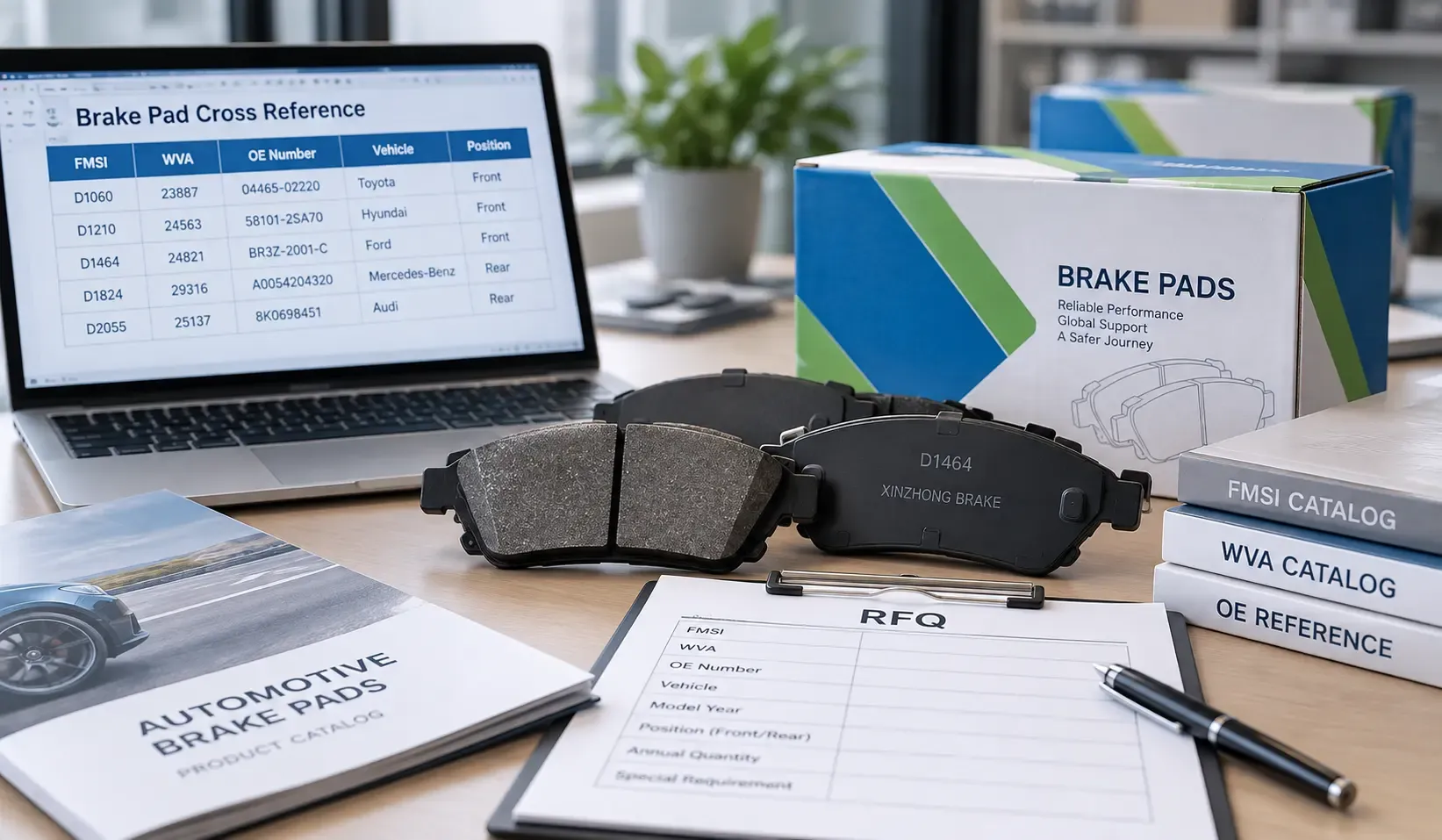
This is also why correct brake pad identification matters. FMSI, WVA and OE numbers can help both sides verify the required products before quotation and production.
3. Choose the Friction Material According to the Market
Private label buyers often ask:
Which material is the best?
There is no universal answer.
Brake pad formulations need to balance braking performance, noise, dust, wear, temperature stability and cost.
Common aftermarket options include:
Ceramic Brake Pads
Often selected for passenger vehicles where buyers value lower noise, cleaner wheels and comfortable braking characteristics.
Semi-Metallic Brake Pads
Commonly used where stronger thermal performance and durability are important.
Low-Metallic Brake Pads
Frequently found in applications requiring strong braking response and heat performance.
NAO Brake Pads
Non-asbestos organic formulations can provide comfortable braking characteristics depending on the formulation and application.
Copper-Free Formulations
Copper-free brake pads are increasingly relevant for markets with environmental requirements or distributors preparing their product range for changing regulations.
A capable manufacturer should not simply offer one formulation for every market.
The formulation should match your positioning, application and target price level.
4. Ask How the Manufacturer Controls Quality Consistency
A sample can perform well.
The bigger question is whether production batch No. 20 performs consistently with the sample you approved.
For distributors, consistency is often more important than chasing one impressive laboratory result.
When evaluating a brake pad manufacturer, ask about:
- Incoming raw material inspection
- Mixing and formulation control
- Pressing process
- Heat treatment
- Scorching
- Grinding and finishing
- Bonding control
- Noise-control measures
- Batch inspection
- Performance testing
- Traceability
Quality management systems such as IATF 16949 and ISO 9001 can also help buyers evaluate whether manufacturing processes are systematically controlled.
5. Decide What You Actually Need Customized
Private label projects can involve several levels of customization.
Product Marking
The backing plate may carry your:
- Brand name
- Part number
- Batch information
- Other agreed markings
Packaging
Depending on quantity and project requirements, customization may include:
- Color box
- Master carton
- Labels
- Barcode
- Installation information
- Brand artwork
Formulation
Different markets may require different friction characteristics or price positioning.
For larger programs, formulation selection can therefore become part of the private label strategy rather than simply choosing a box design.
Accessories
Some applications may require shims, clips, sensors or other accessories.
Confirm what is included before comparing quotations from different suppliers.
A cheaper quotation may not represent the same product configuration.
6. Understand MOQ Before Building Your Product Range
MOQ is particularly important for brake pad private label projects because distributors usually purchase multiple references rather than one product.
There may be different minimum quantities for:
- Each brake pad reference
- Customized packaging
- Printed labels
- Accessories
- Total order value or shipment
Do not look only at the MOQ for one reference.
Ask the manufacturer how different references can be combined into one order.
For a new brand, a flexible mixed-reference strategy can be more useful than an extremely low price with an impractical MOQ.
7. Test Samples Before a Large Order
Samples are useful for checking more than appearance.
Depending on your project, sample evaluation can include:
- Dimensions
- Fitment
- Packaging
- Product marking
- Friction material
- Noise
- Dust
- Braking feel
- Wear
- Laboratory or dynamometer performance
If you already have a successful product in your market, providing a benchmark sample can also help the manufacturer understand the performance level you expect.
The goal is not simply to ask:
Is this brake pad good?
A better question is:
Does this brake pad meet the performance and positioning required for my market?
8. Compare Suppliers Beyond Unit Price
Suppose Supplier A quotes $4.80 and Supplier B quotes $5.10.
That $0.30 difference tells you very little by itself.
You also need to compare:
- Friction formulation
- Included accessories
- Shim configuration
- Packaging
- Testing
- Product coverage
- MOQ
- Lead time
- Claim handling
- Reference accuracy
- Production consistency
A private label supplier becomes part of your brand reputation.
Saving a small amount on purchasing cost can become expensive if incorrect fitment, inconsistent quality or supply problems create customer claims later.
9. Prepare This Information Before Requesting a Quote
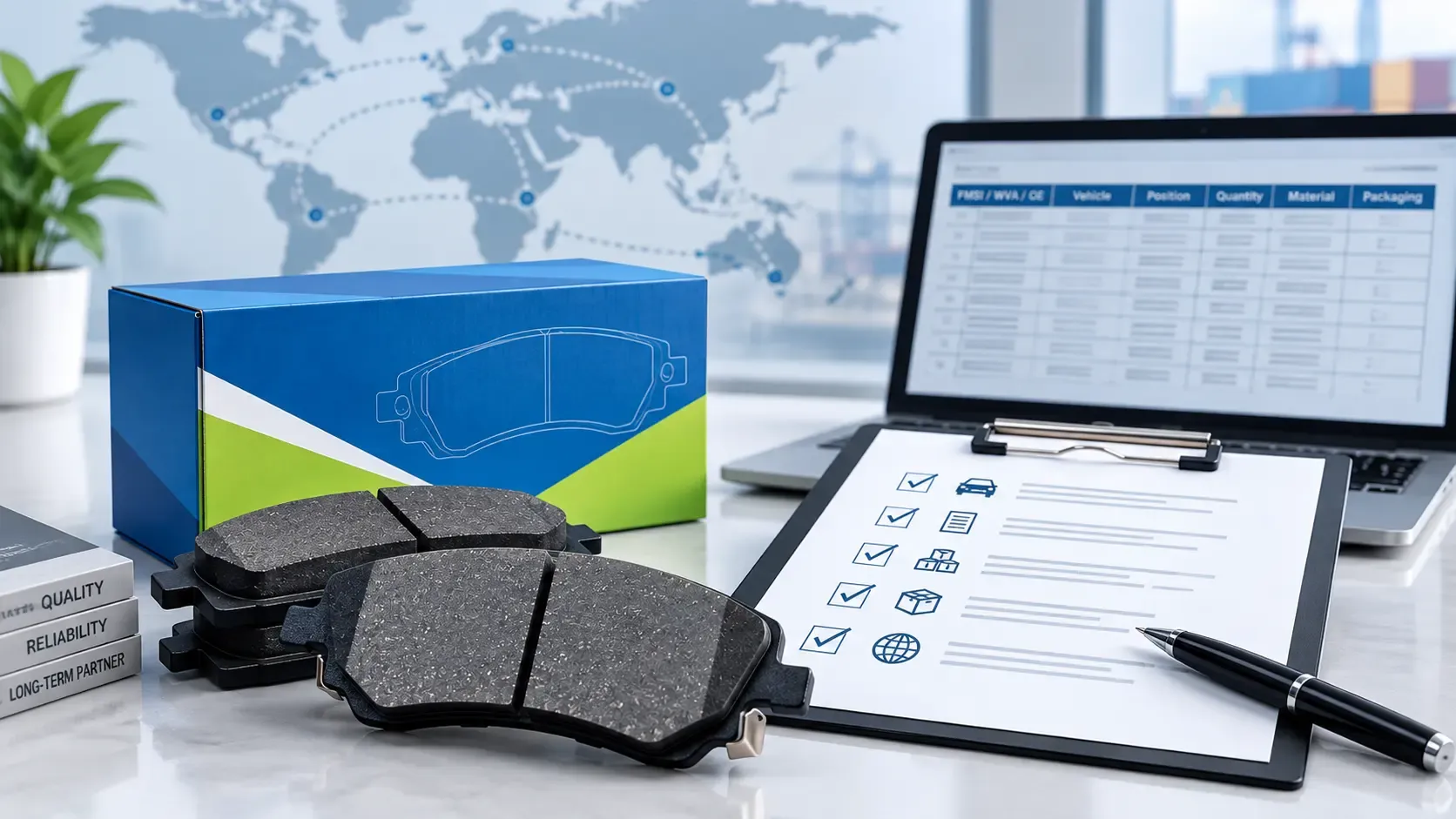
To receive a more accurate quotation, send the manufacturer as much of the following information as possible:
Requirement | Information to Provide |
|---|---|
Market | Country / region |
Product List | OE, FMSI, WVA or application list |
Quantity | Quantity per reference |
Material | Ceramic / semi-metallic / other |
Quality Level | Target performance or benchmark |
Brand | Existing or new private label |
Packaging | Standard or customized |
Accessories | Required configuration |
Certification | Market-specific requirements |
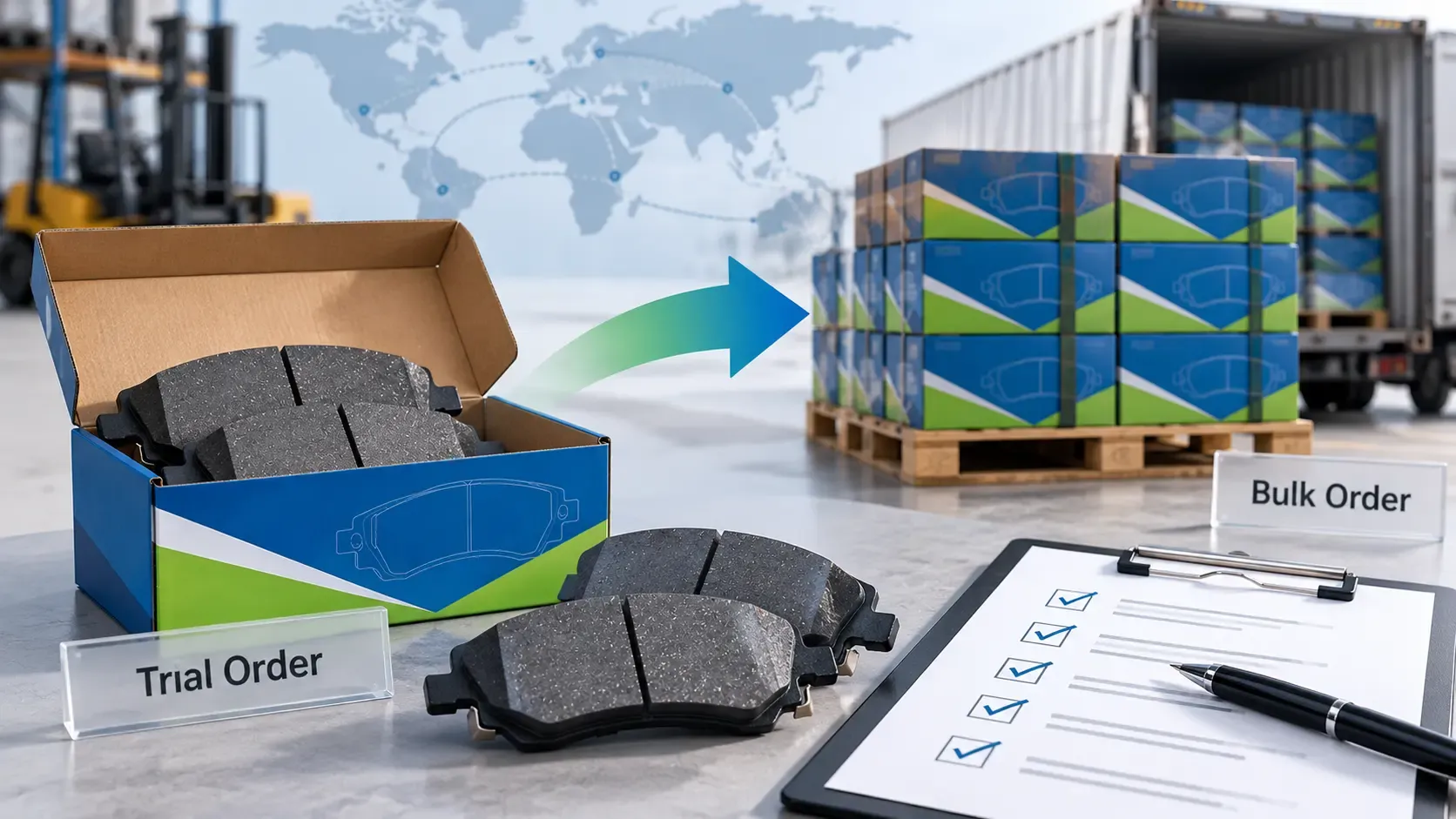
Target Order | Trial order / regular purchasing |
You do not need to have every detail ready.
But the more clearly you describe your market and product positioning, the easier it is for a manufacturer to recommend the right solution.
10. Think Beyond the First Order
A private label brake pad business is rarely built from one shipment.
Before choosing a supplier, consider what happens after the first order.
Can the manufacturer add new references as your business grows?
Can they maintain the same formulation?
Can they reproduce your packaging consistently?
Can they trace production batches?
Can they respond when you receive a fitment or quality complaint?
Can they support your brand as your product range expands?
The first quotation starts the relationship.
Repeatability determines whether the relationship survives.
Private Label Brake Pads From Xinzhong Brake
Xinzhong Brake supports brake pad distributors, importers and aftermarket brands with OEM/ODM and private label manufacturing.
Our manufacturing capabilities include multiple friction material options, broad application coverage and customized branding and packaging solutions.
For buyers developing a new brake pad line, we can work from your:
- OE number list
- FMSI numbers
- WVA numbers
- Vehicle application list
- Existing product samples
- Current sales list
Instead of starting with thousands of references, we can also discuss your priority applications first and build the program step by step.
FAQ
Can I put my own brand on the brake pads and packaging?
Yes. Private label projects can include customized product markings, labels and packaging depending on the order requirements.
Do I need to order thousands of brake pads to start a private label?
Not necessarily. MOQ depends on the references, formulation, packaging and customization requirements. For multi-reference orders, discuss the complete product list with the manufacturer rather than evaluating one reference alone.
Can I send OE or FMSI numbers for quotation?
Yes. OE numbers, FMSI numbers, WVA numbers and vehicle application lists can all help identify the required brake pads.
Can I choose ceramic or semi-metallic formulations?
Yes. The suitable formulation should be selected according to the application, market requirements, performance target and price positioning.
Should I test samples before placing a bulk order?
For a new supplier or new formulation, sample evaluation is strongly recommended before moving to larger-volume purchasing.
Start Your Brake Pad Private Label Project
If you are developing your own brake pad brand or looking for an alternative manufacturing partner, send us your product list.
You can provide OE numbers, FMSI numbers, WVA numbers or vehicle applications, together with your estimated quantities and target market.
We can review the references and discuss suitable formulations, packaging and private label options for your project.